

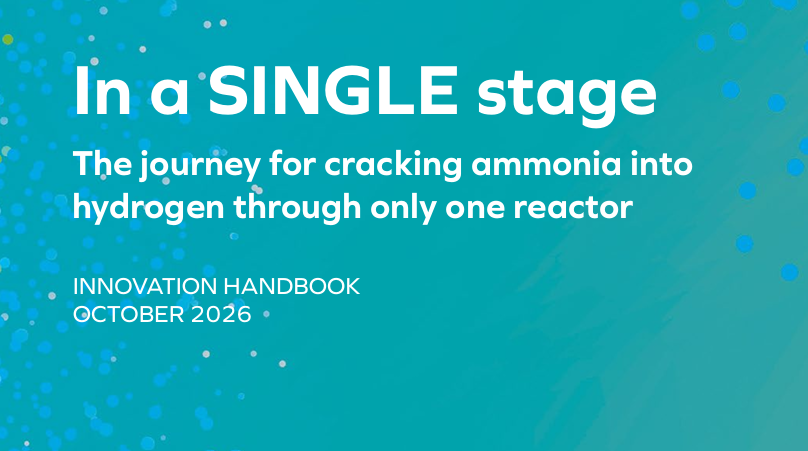
As the EU-funded project approaches its conclusion, SINGLE consortium has released its 48-page Innovation Handbook, called “In a SINGLE stage: The journey for cracking ammonia into hydrogen through only one reactor”. The publication brings together 42 months of research, highlighting the project’s technological achievements, environmental and economic assessments, and lessons learned in advancing ammonia-to-hydrogen technology towards industrial demonstration.
Co-funded by the European Union through the Clean Hydrogen Partnership, SINGLE brought together seven organisations from four European countries, coordinated by CoorsTek Membrane Sciences (Norway).
One reactor, multiple functions
Transporting hydrogen over long distances remains expensive and technically challenging. Ammonia offers an alternative: it can carry hydrogen using established transport and storage infrastructure. However, recovering hydrogen from ammonia traditionally requires three separate processes: cracking, separation and compression.
SINGLE developed a different approach based on proton ceramic electrochemical reactors (PCERs), which integrate these functions into a single device. The technology has the potential to simplify hydrogen production, reduce energy consumption and enable decentralised hydrogen supply close to industrial users.
The Innovation Handbook documents the journey from laboratory research to an integrated reactor module and pilot plant, highlighting both achievements and the challenges encountered along the way.
Beyond the results: lessons for future innovation
“Developing a new technology is not only about proving that it works in the laboratory. It is about understanding what happens when you scale it up, how the different components interact, and what it takes to make the system reliable and economically viable,” said Gautier Papon, SINGLE Project Coordinator at CoorsTek Membrane Sciences. “With this handbook, we wanted to share not only our achievements but also the challenges and lessons learned along the way. We hope this knowledge will help other researchers and industrial players advance ammonia-based hydrogen technologies.”
Rather than presenting innovation as a straightforward process, the film offers an insight into the challenges, achievements and lessons learned throughout the project, highlighting the importance of collaboration between scientific and industrial partners.
The publication also looks beyond SINGLE. Its results will contribute to the development of COUPLE, another European research and innovation project coordinated by CoorsTek Membrane Sciences. Building on SINGLE’s proton ceramic technology, COUPLE will combine complementary membrane technologies to improve hydrogen recovery, energy efficiency and economic performance, targeting the production of 100 kg of high-purity hydrogen per day.
Meet SINGLE at European Hydrogen Week 2026
The Innovation Handbook will be officially showcased during European Hydrogen Week 2026 in Brussels, taking place next week.
Visitors will be able to collect free printed copies of the handbook at the SINGLE project booth in the EU Projects Pavilion, alongside other publications presenting the project’s research and results.
On Tuesday, 27 October, at 13:45, project coordinator Gautier Papon will deliver a presentation highlighting SINGLE’s main achievements, the lessons learned and the opportunities for future development.
Gautier will also be available for one-to-one meetings with researchers, technology developers, industrial stakeholders and other organisations interested in the project’s results and potential collaborations.